
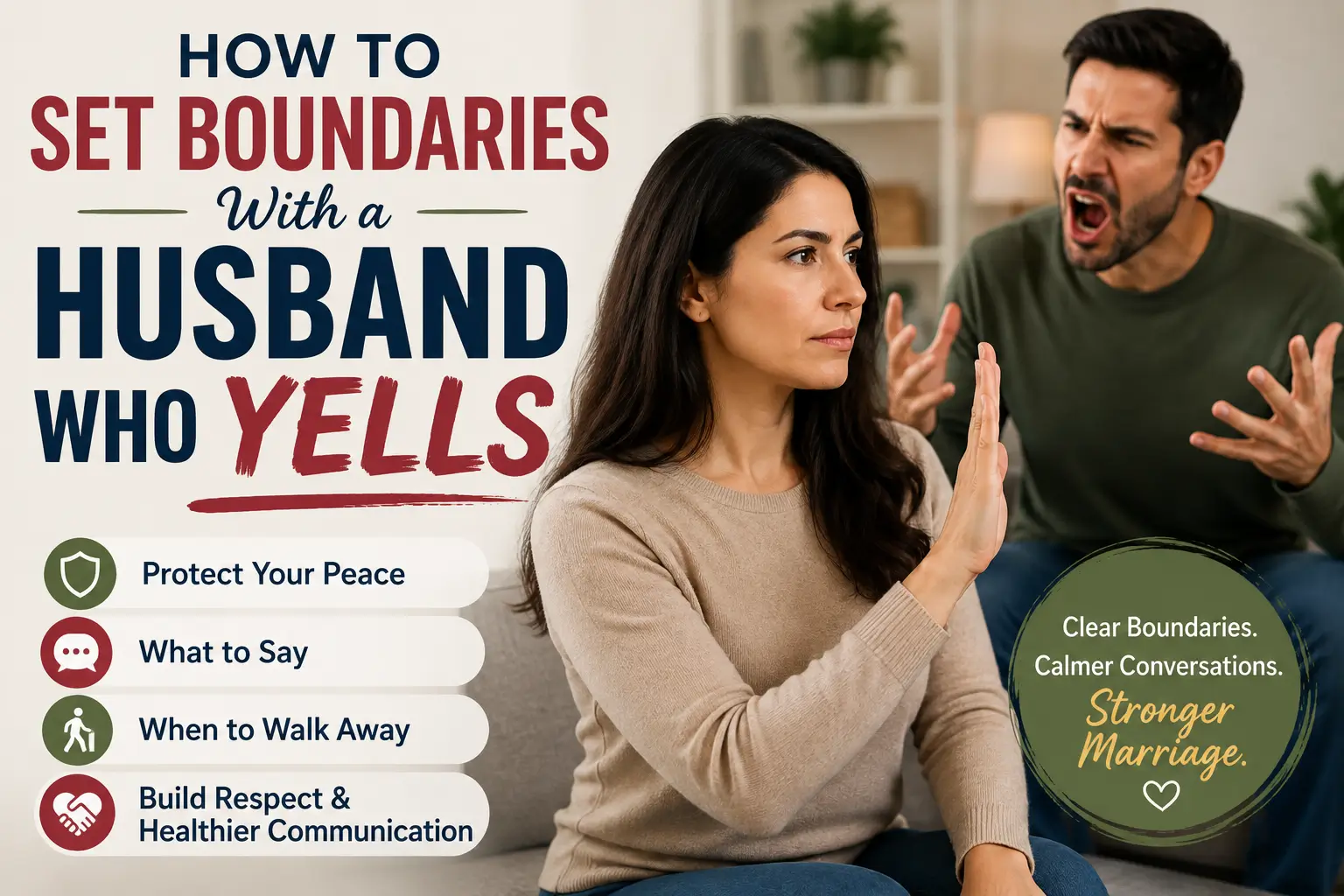
If your husband frequently raises his voice during disagreements, you may know that you don’t want to be yelled at—but still feel unsure about what setting a boundary actually looks like.
Should you tell him to stop?
Walk away?
Refuse to continue the conversation?
What if he says you’re avoiding the issue?
What if you set a boundary and he ignores it?
Learning how to set boundaries with a husband who yells is not about controlling his emotions or forcing him to behave a certain way. A healthy boundary identifies what you are willing to participate in and what you will do when communication crosses that line.
Instead of:
“You are not allowed to yell at me.”
a boundary might sound like:
“I want to discuss this with you. If the conversation turns into yelling, I’m going to pause it and come back when we’re both calmer.”
That distinction matters.
You cannot guarantee that your husband will never yell.
But you can become clearer about how you will respond when he does.
⭐ Quick Answer: How Do I Set a Boundary When My Husband Yells?
To set boundaries with a husband who yells, decide what behavior you will no longer participate in, communicate your boundary calmly, and identify an action that is within your control.
For example:
“I want to hear what you’re saying, but I won’t continue a conversation while I’m being yelled at. If the yelling starts, I’ll pause the conversation and we can try again later.”
Then follow through consistently.
A boundary is not a threat, punishment, or technique for controlling your husband. It is a clear statement about what you will do to protect respectful communication and your own well-being.
What Is a Boundary Around Yelling?
This is where boundary setting often becomes confusing.
A boundary is not simply telling another person what they must do.
For example:
“Stop yelling.”
is a request.
“You can never raise your voice again.”
is an attempt to establish a rule for another person’s behavior.
But:
“If yelling begins, I will pause the conversation.”
is a boundary because the action belongs to you.
You are defining what you will participate in.
This doesn’t mean requests are bad. You can absolutely tell your husband that you want him to speak to you differently.
But a boundary answers an additional question:
What will I do if the behavior continues?
Why “Please Stop Yelling” May Not Be Enough
You may already have told your husband many times:
“Please don’t yell at me.”
And perhaps he agrees afterward.
But then another disagreement happens and the same pattern returns.
This is where a request and a boundary become different.
A request says:
“Please don’t yell.”
A boundary says:
“If yelling starts, I will not continue the conversation in that moment.”
The purpose isn’t to punish him.
It’s to stop repeatedly participating in a type of interaction that you have already identified as unhealthy or unproductive.
Step 1: Decide Exactly What Your Boundary Is
Before communicating a boundary, make it clear to yourself.
“Don’t disrespect me” may express how you feel, but it is difficult to apply consistently because “disrespect” can mean many things.
A more specific boundary might address:
- yelling
- name-calling
- insults
- threats
- conversations that continue after you have asked for a pause
- being followed while trying to disengage
For example:
“If our voices become raised, I’m going to pause the discussion.”
Or:
“If I’m being called names, I’m going to end the conversation.”
Specific boundaries are easier to understand and follow than vague ones.
Step 2: Choose an Action You Can Actually Control
A boundary becomes difficult to maintain when the consequence depends entirely on the other person.
For example:
“If you yell again, you have to leave the room.”
depends on him cooperating.
Compare that with:
“If yelling starts, I’m going to stop participating in the conversation.”
Now the action belongs to you.
Other actions might include:
“I’ll continue this conversation when we’re both calmer.”
“I’m going to take some space and return to this later.”
“If insults begin, I will end the discussion for now.”
Choose something realistic that you are actually prepared to do.
Step 3: Communicate the Boundary When Things Are Calm
If possible, don’t introduce an important boundary for the first time in the middle of an explosive argument.
Choose a calmer moment.
You might say:
“I want us to be able to talk about difficult things. I’ve noticed that when conversations become yelling, neither of us communicates well. Going forward, if yelling starts, I’m going to pause the conversation and come back to it when we’re calmer.”
Notice the structure:
I want us to communicate.
Here is the behavior I’m addressing.
Here is what I will do.
You aren’t threatening the marriage.
You aren’t diagnosing him.
You aren’t debating whether he is “a yeller.”
You’re explaining how you intend to handle a specific communication pattern.
Step 4: Keep the Boundary Short During the Argument
Once yelling begins, you don’t need to deliver a five-minute speech about your boundary.
You already communicated it.
Use a short reminder:
“I’m going to pause this conversation now.”
Or:
“I want to talk about this, but not while we’re yelling.”
Or:
“I’ll come back when we can speak calmly.”
Then follow through if it is safe to do so.
Repeatedly explaining the boundary while remaining inside the same escalating argument can turn the boundary itself into another subject to fight about.
Step 5: Follow Through Consistently
This is often the hardest part.
Imagine that you say:
“If yelling starts, I’ll pause the conversation.”
Then the next time he yells, you stay for another 30 minutes arguing your point.
Your husband may learn that the boundary doesn’t actually change what happens.
Consistency doesn’t mean perfection.
But over time, your actions should match what you said.
If your boundary is that you will pause conversations involving yelling, then when yelling begins:
Pause.
You don’t need to punish him afterward.
You don’t need to give him the silent treatment.
You simply follow the boundary you established.
What Should I Say When I Set the Boundary?
Here are several examples.
If you want to keep talking but the yelling needs to stop:
“I want to resolve this. I’m willing to keep talking when we can speak without yelling.”
If you need to leave the conversation:
“I’m going to take a break now. We can come back to this when we’re calmer.”
If he is insulting you:
“I’m willing to discuss the problem. I’m not willing to continue while I’m being called names.”
If he says you’re avoiding the conversation:
“I’m not refusing to discuss it. I’m pausing the way we’re discussing it.”
If he says you’re being too sensitive:
“You don’t have to experience it the same way I do. I’m still choosing not to continue conversations that involve yelling.”
If he says you caused the yelling:
“I’m willing to discuss my part in the disagreement. I’m not taking responsibility for how you choose to speak to me.”
For more phrases specifically designed for the moment an argument is escalating, read What to Say When Your Husband Is Yelling at You.
Is Walking Away From Yelling a Healthy Boundary?
It can be.
Walking away becomes problematic when it is used to punish your spouse, manipulate him, or permanently avoid necessary conversations.
That’s different from saying:
“This conversation isn’t productive right now. I’m going to take a break and return to it later.”
The intention matters.
A healthy pause says:
We’re going to address this—but not like this.
Whenever possible, give some indication that you intend to return to the discussion.
For example:
“I need 30 minutes. Let’s talk again afterward.”
That can help distinguish a boundary from stonewalling.
What If My Husband Ignores My Boundary?
This is an important question because saying a boundary once does not guarantee another person will respect it.
Suppose you’ve explained:
“If yelling starts, I’ll pause the conversation.”
And he continues yelling.
Your job isn’t necessarily to convince him that your boundary is reasonable while he is angry.
Your job is to follow through on the part you control.
You might say:
“I’ve told you I’m not continuing while we’re yelling. I’m going to take the break now.”
Then disengage if you can do so safely.
Over time, pay attention to what happens.
Does he gradually respect the pause?
Does he calm down and return to the conversation?
Does he repeatedly ignore your requests for space?
Does he become more intimidating when you try to disengage?
Those distinctions matter.
What If He Follows Me When I Try to Walk Away?
This moves beyond an ordinary disagreement about communication.
If you ask for space and your husband follows you from room to room while continuing to yell, blocks a doorway, prevents you from leaving, takes your phone, threatens you, damages property, or makes you afraid of what he may do, don’t treat the situation as simply a boundary-setting exercise.
Your priority becomes safety.
A communication technique is not an adequate solution to threatening or physically intimidating behavior.
Seek appropriate professional or emergency support if you believe you are in danger.
What If He Says My Boundary Is Controlling?
A useful question is:
Am I telling him what he is allowed to feel and do—or am I deciding what I will participate in?
Compare:
“You’re not allowed to be angry.”
with:
“You can be angry. I’m not willing to be yelled at while we discuss it.”
You aren’t requiring him to agree with your feelings.
You’re identifying the conditions under which you are willing to participate in a conversation.
He may dislike the boundary.
Disliking a boundary and being controlled by one are not necessarily the same thing.
Should There Be a Consequence When My Husband Yells?
The word consequence can easily make boundaries sound like punishment.
Instead, think in terms of what naturally happens when your boundary is crossed.
For example:
Yelling begins → conversation pauses.
Name-calling begins → you stop participating.
Conversation becomes respectful → discussion can resume.
The purpose isn’t:
“I’ll show you what happens when you yell at me.”
It’s:
“This is how I’m going to respond when communication becomes unhealthy.”
That difference is important.
What If I Set the Boundary and Then Break It Myself?
You may intend to pause but become defensive and start yelling back.
That doesn’t mean the boundary failed forever.
Recognize what happened.
Reset.
And practice again.
You might later say:
“I didn’t handle that the way I intended either. Next time I want to pause earlier before we both become reactive.”
Boundary setting is not about becoming emotionally perfect.
It’s about developing a more consistent response to a recurring pattern.
Can Boundaries Make My Husband Stop Yelling?
Boundaries may change the way you participate in the cycle, but they cannot guarantee that your husband will change his behavior.
That’s an important distinction.
A boundary shouldn’t become another strategy for trying to control him:
“If I do this correctly, he’ll finally stop yelling.”
Instead, a boundary gives you clarity.
You learn:
What am I willing to participate in?
What will I do when the yelling starts?
Does he respect reasonable limits?
Does the relationship become healthier over time?
Your husband’s response to a reasonable boundary can itself provide useful information about the relationship.
What If He Apologizes but Keeps Yelling Again?
An apology can be meaningful.
But when you’re evaluating a repeated pattern, look beyond what happens immediately afterward.
Ask:
Does he acknowledge the behavior?
Does he respect the boundary next time?
Does the yelling become less frequent?
Does he make an effort to communicate differently?
Does anything actually change?
If your husband frequently yells, calms down, returns to normal, and then the same cycle starts again without meaningful repair, read Why Does My Husband Yell and Then Act Like Nothing Happened?
That article focuses specifically on the difference between ending an argument and repairing what happened.
Boundaries Are Not About Walking on Eggshells
There’s an important paradox here.
Women sometimes think boundary setting means learning an increasingly complicated list of ways to prevent their husband’s anger.
That’s not the goal.
A boundary isn’t:
“I must make sure I never say anything that triggers him.”
A boundary is closer to:
“I will communicate thoughtfully, and I know what I will do if the conversation becomes yelling.”
If your husband tends to have disproportionately intense reactions to minor issues, read My Husband Yells at Me Over Small Things: Why It Happens & What to Do.
That article focuses on the difference between understanding triggers and becoming responsible for preventing every reaction.
When Is a Boundary Not Enough?
Boundaries are useful relationship tools.
But they are not a cure for every situation.
Take the larger pattern seriously if yelling includes:
- threats
- intimidation
- humiliation
- coercive or controlling behavior
- destruction of property
- physical aggression
- blocking you from leaving
- preventing access to a phone, transportation, money, or help
- making you genuinely afraid of what will happen if you disagree
In those situations, the question may no longer be:
“How do I communicate my boundary better?”
It may be:
“What support do I need to protect myself?”
If you believe you are in immediate danger, prioritize getting to safety and contacting appropriate emergency support.
How Boundaries Fit Into the Bigger Yelling Pattern
This article focuses specifically on how to establish and maintain boundaries around recurring yelling.
If you’re asking why your husband is yelling in the first place, read Why Is My Husband Yelling at Me? Reasons & What to Do.
For a deeper look at emotional flooding, stress, learned conflict patterns and emotional regulation, read Psychology of Yelling in Marriage: Why Angry Outbursts Happen.
If minor problems repeatedly trigger intense reactions, read My Husband Yells at Me Over Small Things: Why It Happens & What to Do.
For specific phrases you can use during an escalating conversation, read What to Say When Your Husband Is Yelling at You.
And if he yells and then quickly behaves as though nothing happened, read Why Does My Husband Yell and Then Act Like Nothing Happened?
Each of these patterns requires a slightly different question.
🌿 How I Help Women Build Clarity and Stronger Boundaries
When yelling becomes a recurring part of your marriage, it can be difficult to know where your responsibility ends and your husband’s begins.
You may wonder:
Should I communicate differently?
Am I being too sensitive?
Should I let this go?
Should I speak up?
What boundary is reasonable?
In my relationship coaching for women, I help women become clearer about the patterns they are participating in and the choices that remain within their control.
Through the SADAF Method, we focus on emotional steadiness, communication, clarity, self-respect, boundaries, and connection—without making you responsible for another adult’s behavior.
The goal isn’t to teach you how to control your husband.
It’s to help you become more intentional about what you say, what you participate in, what you step away from, and what you need in order for the relationship to become healthier.
Frequently Asked Questions
What is a good boundary for a husband who yells?
A simple boundary might be: “If yelling starts, I will pause the conversation and return when we can speak calmly.” The important part is that the action is something you control and are prepared to follow.
How do I tell my husband I won’t tolerate yelling?
Choose a calm moment if possible. You could say: “I want us to be able to discuss difficult things, but I’m not willing to continue conversations while I’m being yelled at. If that happens, I’ll take a break and return later.”
Is leaving the room when my husband yells a boundary?
It can be, particularly if you’re taking space to prevent escalation rather than using withdrawal as punishment. When appropriate, communicate that you intend to return to the discussion.
What if my husband keeps yelling after I ask him to stop?
You don’t have to repeatedly argue about whether he should stop. Follow the part of your boundary that you control by pausing or ending your participation in the conversation when it is safe to do so.
What if my husband says I am controlling him?
A boundary should focus primarily on your behavior rather than controlling his feelings. “You cannot be angry” attempts to control his emotion. “I won’t continue a conversation while I’m being yelled at” describes what you will do.
What if my husband won’t let me walk away?
If he physically blocks you, follows you in an intimidating way, threatens you, or prevents you from safely disengaging, treat that as more serious than an ordinary communication problem and prioritize appropriate safety support.
Can boundaries actually stop my husband from yelling?
They may help change the interaction pattern, but boundaries cannot guarantee another person’s behavior. Their primary purpose is to clarify what you will participate in and how you will respond.
Should I threaten divorce if my husband keeps yelling?
Avoid using divorce as a threat simply to force immediate compliance. If you are genuinely considering separation or divorce because of the relationship pattern, that is a larger decision that deserves careful consideration rather than being used as leverage during an argument.
A Boundary Is About What You Will Do Next
Learning to set boundaries with a husband who yells isn’t about finding a sentence powerful enough to control his behavior.
It’s about becoming clear.
What kind of communication will you participate in?
When will you pause?
What will you do if the boundary is ignored?
Can difficult conversations eventually resume respectfully?
Is the overall pattern actually changing?
You can work on warmth, communication, understanding, and connection while still having limits around how you are willing to be treated.
If you’re struggling to distinguish between what you can influence and what you cannot—or you’re unsure how to respond consistently when yelling begins—relationship coaching can help you identify the pattern and create clearer next steps.