
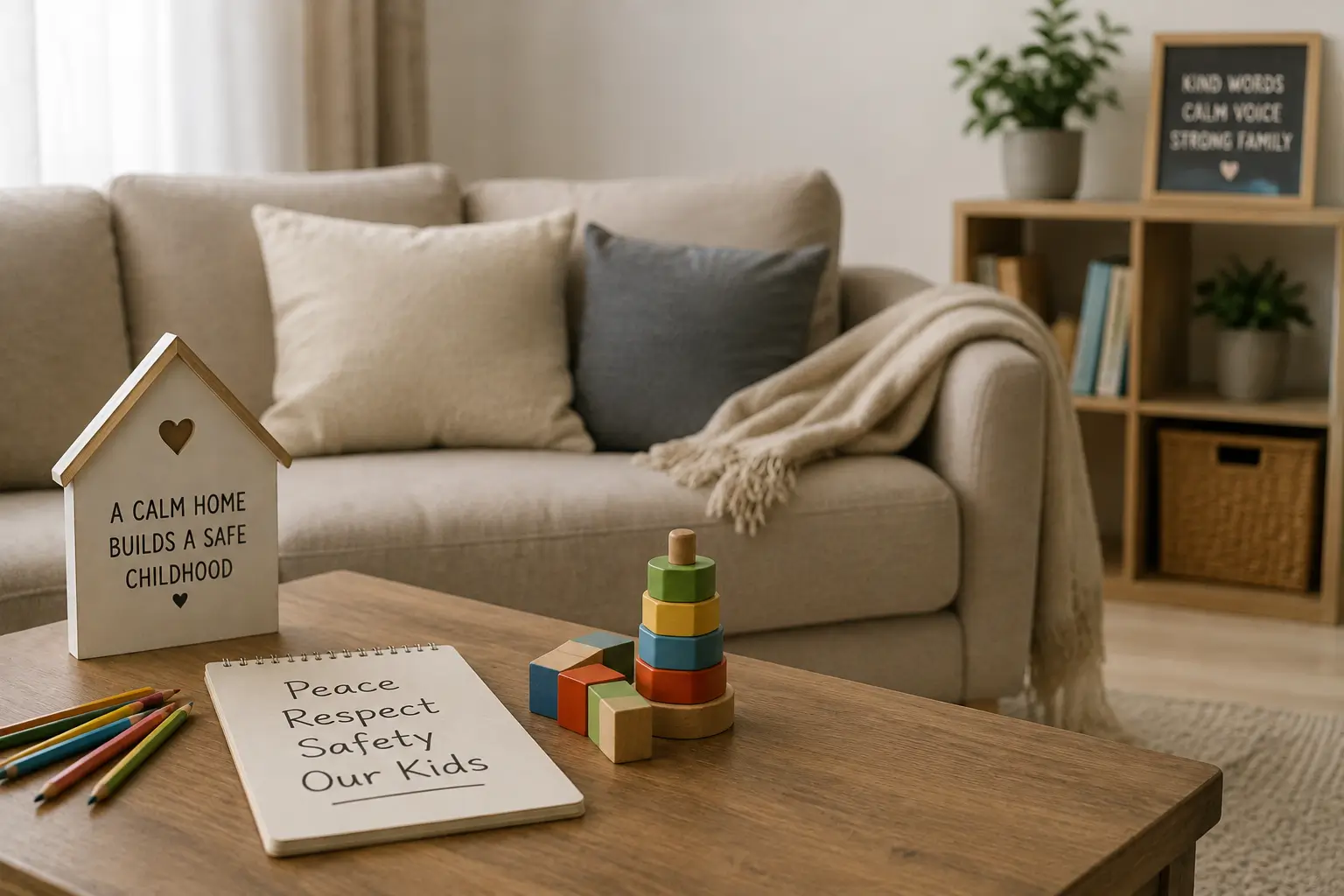
When your husband yells at you, it can already be painful. But when it happens in front of your children, the situation can feel much more serious.
You may find yourself wondering:
“What is this doing to my kids?”
“Should I defend myself or stay quiet?”
“Should I take the kids out of the room?”
“What should I tell them afterward?”
“How do I get my husband to understand that this needs to stop?”
If your husband yells at you in front of the kids, your goal is not to win the argument or prove who is right. Your immediate priority is to reduce escalation and protect the emotional environment around your children.
Then, when things are calmer, you can address the larger pattern.
Quick Answer: What Should I Do If My Husband Yells at Me in Front of the Kids?
If your husband begins yelling at you in front of your children, avoid turning the situation into a louder argument if you can safely disengage.
You can say something simple such as:
“I want to talk about this, but not while we’re yelling in front of the kids. Let’s continue later.”
If appropriate and safe, pause the conversation and create some distance from the conflict.
Afterward, reassure your children without asking them to take sides. Then address the yelling with your husband privately when both of you are calmer.
If the yelling involves threats, intimidation, destruction of property, physical aggression, preventing you from leaving, or fear for anyone’s safety, treat the situation as more than an ordinary communication problem and seek appropriate professional or safety support.
Why Yelling in Front of the Kids Deserves Attention
Children don’t need a conflict-free home.
Parents will disagree.
They will occasionally become frustrated.
Children can even learn something valuable from watching adults disagree respectfully and repair the relationship afterward.
But repeated hostile yelling is different.
A child doesn’t necessarily understand the disagreement the way two adults do.
Your child may simply experience:
Mom and Dad are angry.
Something bad might happen.
I don’t know when this will stop.
Maybe I caused this.
I need to stay out of the way.
This is why the emotional climate surrounding the conflict matters.
What Children May Do When Parents Yell
Children respond differently depending on their age, temperament, frequency of exposure and what the yelling involves.
Some children may:
- become unusually quiet
- leave the room when tension starts
- cry
- cover their ears
- try to interrupt the argument
- attempt to make one parent feel better
- become irritable themselves
- worry about whether their parents will separate
- become more sensitive to raised voices
- start monitoring their parents’ moods
A child may also appear completely unaffected.
That doesn’t necessarily tell you what the child is experiencing internally.
Instead of assuming, pay attention to changes in behavior and create opportunities for your child to talk without pressuring them.
What to Do While Your Husband Is Yelling in Front of the Kids
When yelling begins, it can be tempting to immediately defend yourself.
Sometimes you may have every reason to defend your position.
But while emotions are escalating, proving your point may not be the most important objective.
1. Don’t Compete With His Volume
If possible, avoid yelling louder so that you can finally be heard.
Two adults shouting at each other usually increases the intensity children are witnessing.
Speak briefly and calmly.
For example:
“I’m willing to discuss this, but not while we’re yelling.”
Or:
“Let’s pause this conversation and come back to it later.”
You don’t need a long explanation.
2. Don’t Make the Children the Referees
Avoid statements such as:
“See how your father talks to me?”
“Tell your dad he’s being unreasonable.”
“Your father always does this.”
Even when you are genuinely hurt, asking children to judge the disagreement places them inside an adult conflict.
The issue should remain between the adults.
3. Pause the Argument When Possible
If the discussion can wait, let it wait.
You can return to the subject later when the children aren’t present and both of you have had time to calm down.
Pausing is not the same as pretending the problem didn’t happen.
It means choosing a better environment in which to address it.
If you need specific phrases for de-escalating the conversation, read What to Say When Your Husband Is Yelling at You.
What Should I Tell My Children After My Husband Yells at Me?
This is one of the most important parts of the situation.
Don’t assume that because the argument ended, your children have automatically moved on.
You don’t need to give them the details of your marital disagreement.
Instead, keep the explanation simple and appropriate for their age.
You might say:
“Dad and I got upset with each other. The yelling wasn’t a good way for us to handle it. This wasn’t your fault, and you don’t need to fix anything between us.”
That communicates several important things:
The child didn’t cause the conflict.
The child isn’t responsible for resolving it.
Yelling isn’t being presented as ideal communication.
The adults remain responsible for the adult relationship.
Avoid giving children information that pressures them to choose sides.
What If My Child Asks, “Why Was Dad Yelling at You?”
You don’t have to lie.
But you also don’t need to turn your child into your confidant.
You can say:
“Dad was very upset, and he raised his voice. Adults sometimes handle frustration badly too. We’re responsible for working through that.”
If your child says the yelling frightened them, listen.
You don’t have to immediately explain your husband’s intentions.
You can first acknowledge their experience:
“I can understand why hearing loud yelling felt scary.”
Then reassure them appropriately.
Should I Talk to My Husband About Yelling in Front of the Kids?
Yes—if it is safe to do so.
But the middle of the yelling episode is usually not the best time for a lengthy conversation about his yelling.
Wait until the situation is calmer.
Instead of beginning with:
“You traumatized the kids again.”
you might say:
“I want us to talk about what happened earlier. Whatever disagreement we’re having, I don’t want us handling it by yelling in front of the kids. We need another way to pause these conversations when they’re escalating.”
Keep the discussion focused.
The immediate issue is not every marital problem you’ve ever had.
It is:
How are we going to handle disagreements when the children are present?
What If My Husband Says, “The Kids Are Fine”?
You may hear:
“They weren’t even paying attention.”
“Every couple argues.”
“You’re making this into a bigger deal than it is.”
It is true that disagreement between parents is normal.
But the question isn’t whether children should ever see their parents disagree.
A healthier question is:
What are our children repeatedly learning about how people who love each other handle frustration?
Children benefit from seeing disagreement handled with respect.
They can also benefit from seeing repair after a conflict goes badly.
The goal isn’t perfection.
It’s creating a healthier pattern.
Repair in Front of the Kids Can Matter Too
If your children witnessed the conflict, there can be value in allowing them to witness appropriate repair when possible.
For example, they might hear:
“I shouldn’t have yelled earlier. I was frustrated, but I should have handled it differently.”
Or:
“Mom and I disagreed, but we’re working it out.”
This teaches something very different from pretending nothing happened.
Children can learn:
People sometimes make mistakes.
Anger doesn’t eliminate responsibility.
Apologies matter.
Relationships can survive disagreement.
Repair is part of healthy connection.
If your husband frequently yells and then immediately behaves as though nothing happened, read Why Does My Husband Yell and Then Act Like Nothing Happened?
What If My Husband Blames Me for Making Him Yell?
Perhaps you made a mistake.
Maybe you criticized him.
Maybe you raised an issue at a bad time.
Maybe you became frustrated too.
You can take responsibility for your behavior without accepting responsibility for someone else’s behavior.
For example:
“I shouldn’t have said that the way I did, and I can take responsibility for that. But I don’t want either of us yelling in front of the children.”
This distinction matters.
Accountability does not require you to conclude:
“If I behaved perfectly, he wouldn’t yell.”
If blame shifting frequently happens in your marriage, read Signs Your Husband Is Blame Shifting in Marriage.
What If He Yells Over Very Small Things in Front of the Kids?
Sometimes the most unsettling part isn’t simply the volume.
It’s the unpredictability.
A forgotten errand.
A child making noise.
Someone running late.
A question.
A spilled drink.
A disagreement about plans.
When relatively minor events repeatedly produce disproportionate anger, everyone in the household can begin anticipating the next reaction.
You may start trying to eliminate every possible trigger.
Your children may start doing the same.
If seemingly small situations regularly lead to your husband’s yelling, read My Husband Yells at Me Over Small Things: Why It Happens & What to Do.
Am I Teaching My Children to Walk on Eggshells?
This is worth considering carefully.
If you constantly monitor your husband’s mood before speaking, your children may notice that pattern.
They may observe you:
- becoming quiet when he seems irritated
- warning everyone not to upset him
- changing plans around his mood
- apologizing quickly to stop conflict
- avoiding reasonable questions
- trying to keep everyone perfectly behaved
Sometimes this begins as an understandable attempt to keep the household calm.
But over time, the entire family can start organizing itself around one person’s reactions.
If you recognize this pattern in yourself, read How to Stop Walking on Eggshells Around Your Husband.
How to Set a Boundary Around Yelling in Front of the Kids
A boundary is most useful when it describes what you will do, rather than attempting to control another adult.
Instead of:
“You are never allowed to raise your voice again.”
consider:
“If our conversation turns into yelling while the kids are present, I’m going to pause the conversation. We can return to it privately when we’re calmer.”
Then consistency matters.
But there is an important qualification.
If attempting to pause an argument causes your husband to follow you, block your exit, threaten you, destroy things, become physically aggressive, or retaliate against you, this is no longer simply a question of finding a better communication technique.
Safety takes priority.
What If My Children Are Becoming Afraid of Their Father?
Take that seriously.
Ask yourself what your children are actually afraid will happen.
Are they uncomfortable because Dad sometimes gets loud?
Or are they afraid that he might:
- threaten someone
- hurt someone
- destroy something
- punish them unpredictably
- prevent someone from leaving
- become physically aggressive
Those situations require different levels of response.
Don’t pressure a child to minimize fear simply because the yelling has become familiar to the adults.
And don’t make the child responsible for confronting the parent.
If there is a genuine safety concern, seek appropriate professional support rather than relying solely on relationship communication strategies.
What If I Am Walking on Eggshells Too?
Sometimes children aren’t the only ones anticipating the next outburst.
You may be doing it too.
You may check your husband’s mood before mentioning something.
You may rehearse conversations.
You may hide small mistakes.
You may overexplain.
You may abandon reasonable requests.
You may think:
“How do I say this without setting him off?”
If this describes your experience, the issue may extend beyond individual arguments.
Read How to Stop Walking on Eggshells Around Your Husband to understand how this pattern develops and what you can begin changing.
When Yelling in Front of the Kids Is More Serious
Not every raised voice between parents means a family is unsafe.
But repeated yelling deserves more serious attention when it involves:
- threats
- intimidation
- humiliation
- insults or degrading language
- destruction of property
- physical aggression
- preventing someone from leaving
- extreme controlling behavior
- children hiding because they are afraid
- retaliation when someone disagrees
If you or your children fear physical harm, prioritize appropriate safety and professional support.
Relationship coaching should not be treated as a substitute for emergency, domestic-violence, medical or mental-health services when those services are needed.
How Do We Stop This From Becoming Our Family’s Normal?
Patterns become normal through repetition.
Changing the pattern requires something different to happen before, during and after conflict.
Before:
Notice situations that regularly lead to escalation.
During:
Pause conversations that are becoming hostile when it is safe to do so.
After:
Don’t simply pretend nothing happened.
Repair.
Talk about what went wrong.
Take responsibility where appropriate.
Decide what should happen differently next time.
And repeat the healthier response consistently.
If you want to understand the broader reasons yelling can become a recurring marital pattern, read Psychology of Yelling in Marriage: Why Angry Outbursts Happen.
Can a Marriage Recover From Repeated Yelling in Front of the Kids?
Sometimes, yes.
A healthier household doesn’t require two people who never become frustrated.
It requires adults who increasingly learn how to handle frustration without turning the household into an emotionally volatile environment.
Progress may look like:
A disagreement remains a disagreement.
Someone notices escalation and pauses.
Voices come back down.
A parent apologizes after handling something badly.
Children stop anticipating the next argument.
Difficult subjects can be discussed without everyone becoming tense.
The goal isn’t to create a family where nobody ever gets upset.
The goal is to create a family where anger doesn’t control the emotional climate.
Does Your Child’s Age Change How You Should Respond?
If You Have Young Children
Focus on simple reassurance, removing them from escalating conflict when safe, avoiding adult details, and clearly communicating that they did not cause the argument and aren’t responsible for fixing it.
If You Have Teenagers
This is different. Teens understand far more of what’s happening and may form strong opinions, become angry at one parent, defend you, challenge their father, withdraw, or feel pressured to take sides.
The goal becomes acknowledging what they witnessed without recruiting them into your marital conflict.
If You Have Adult Children
Adult children may want to intervene, confront their father, give you marriage advice, or become your emotional support system.
You can be more candid with an adult child than with a young child, but I would still emphasize maintaining a parent-child boundary rather than turning an adult son or daughter into your counselor or mediator.
How Relationship Coaching Can Help
When your husband frequently yells in front of the children, you may feel caught between several concerns at once.
You want to protect your children.
You want your marriage to improve.
You don’t want to make arguments worse.
And you may not know what you can realistically change when your husband is the one yelling.
In my relationship coaching for women, we can look at your specific pattern rather than assuming every marriage is the same.
We can identify what tends to happen before escalation, how you currently respond, where you may be taking responsibility for things you cannot control, what communication changes are appropriate, and what boundaries may be necessary.
The goal is not to teach you how to keep your husband from ever becoming angry.
The goal is to help you become clearer and more intentional about your response, your boundaries, your emotional steadiness and your next steps.
Frequently Asked Questions: My Husband Yells at Me in Front of the Kids
Is it normal for parents to yell in front of their children?
Parents occasionally lose their temper, and one raised voice does not define an entire family. However, frequent hostile yelling, intimidation or conflict that causes children to become fearful deserves attention. The pattern, intensity and what happens afterward all matter.
What should I do immediately when my husband starts yelling in front of the kids?
If it is safe, avoid escalating the argument and try to pause the conversation. A short statement such as, “Let’s continue this conversation privately when we’re calmer,” may be more effective than trying to resolve the disagreement while emotions are high.
Should I take my children out of the room when my husband yells?
If you can safely reduce your children’s exposure to an escalating argument, creating distance may be appropriate. If you believe anyone is in physical danger, prioritize safety and seek appropriate assistance.
Should I tell my children their dad was wrong for yelling?
You can acknowledge that yelling wasn’t a healthy way to handle the disagreement without asking your children to judge or choose between their parents. Keep explanations age-appropriate and reassure them that the adult conflict is not their responsibility.
What should I say to my child after they hear us arguing?
You might say, “We got upset and didn’t handle the disagreement very well. It wasn’t your fault, and you don’t need to fix it.” Adapt the language to your child’s age and circumstances.
What if my husband yells at the children too?
Pay attention to the frequency, intensity and nature of the yelling. Frustration is different from threats, humiliation, intimidation or physical aggression. If your children are frightened or you have concerns about their safety or well-being, seek appropriate professional support.
Why does my husband yell and then act normal around the kids?
He may consider the conflict finished once his anger subsides, while you or your children remain emotionally affected. The absence of repair can make repeated conflicts especially confusing. This is why acknowledging what happened afterward can matter.
Am I responsible for stopping my husband from yelling in front of our children?
You can influence how you communicate and whether you continue participating in an escalating argument, but you cannot take responsibility for another adult’s emotional regulation or behavior.
You Don’t Have to Keep Managing Everyone’s Reactions
When yelling becomes part of family life, you may gradually take on the role of emotional manager.
You watch your husband’s mood.
You keep the children quiet.
You avoid difficult subjects.
You choose every word carefully.
You try to prevent the next argument before it starts.
Eventually, your entire household can begin revolving around avoiding one person’s reaction.
That isn’t the same as peace.
You can care about your husband, care deeply about your marriage, and still recognize that yelling in front of your children needs to change.
You are responsible for how you communicate.
Your husband is responsible for how he communicates.
And your children should not have to carry responsibility for either one.
If you’re struggling to understand what you can change in your particular situation, relationship coaching can help you look at the pattern more clearly and decide what healthier next steps look like.