
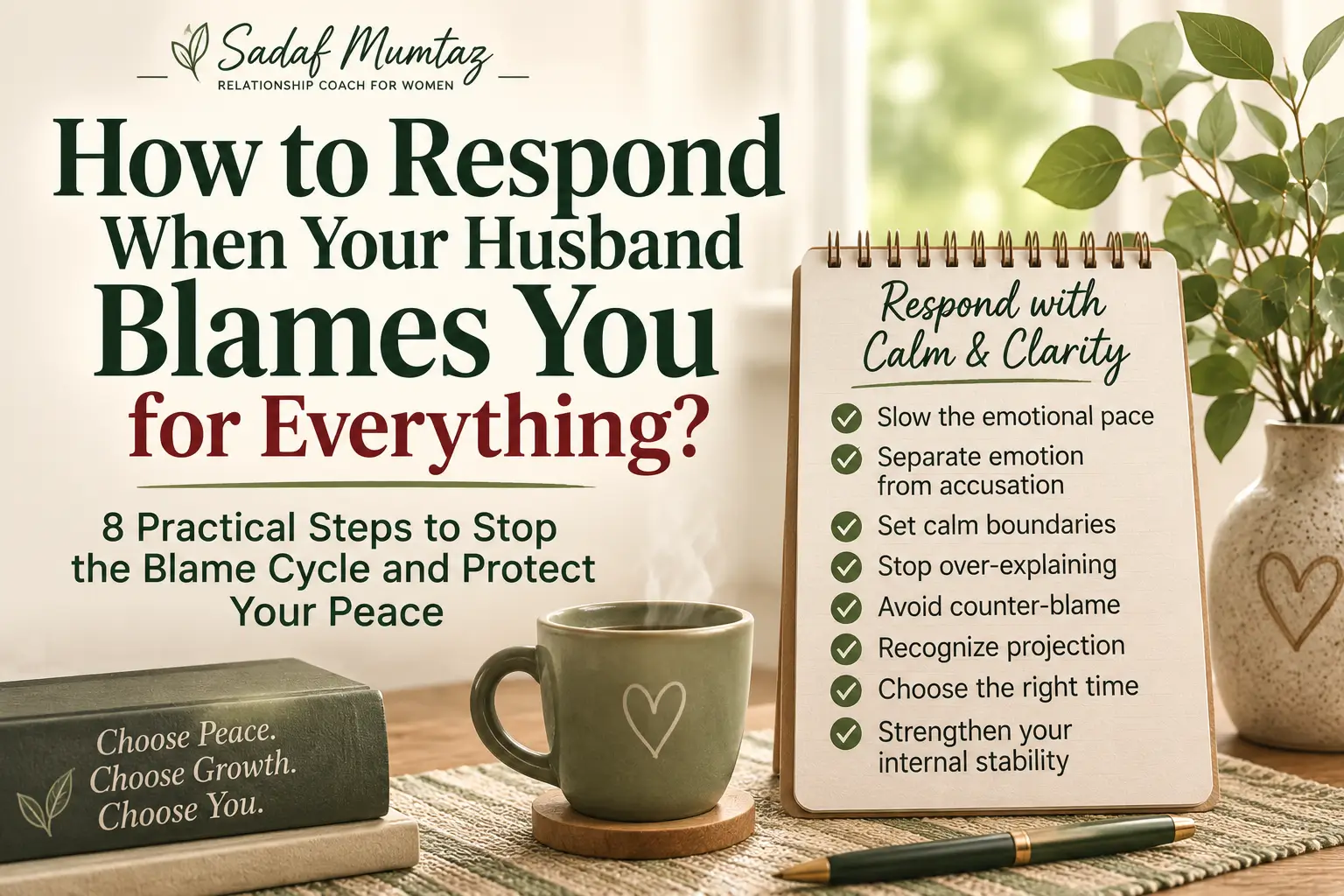
If you’re wondering how to respond when your husband blames you for everything, you’re not alone. Constant blame can make you defensive, frustrated, or emotionally exhausted.
When your husband blames you for everything, your first instinct is usually to defend yourself.
You want to correct the facts.
You want to explain what really happened.
You want him to see that it wasn’t your fault.
But if you’ve been in this pattern long enough, you already know something:
Defending yourself often makes it worse.
If you are dealing with constant blame, you may first want to understand the deeper psychology behind it. I explain that fully in this guide on why my husband blames me for everything. In this article, we’ll focus specifically on what to do in the moment — and how to respond without escalating conflict or shrinking yourself.
Why Your Usual Responses Aren’t Working
When blame becomes habitual, most women respond in one of three ways:
- Over-defending
- Over-explaining
- Withdrawing completely
All three reactions are understandable.
But none of them interrupt the blame cycle.
Over-defending triggers defensiveness in him.
Over-explaining signals insecurity.
Withdrawing builds resentment.
To change the pattern, you need a different response structure.
8 Practical Steps: How to Respond When Your Husband Blames You for Everything
Step 1: Slow the Emotional Pace Immediately
Blame thrives in fast, reactive conversations.
When he says:
“This is your fault.”
Your nervous system spikes.
Instead of matching his pace, slow everything down.
Lower your voice.
Pause before speaking.
Shorten your sentences.
Try:
“I can see you’re upset.”
“Let’s slow this down.”
“I want to understand what’s happening here.”
Slowing the emotional tempo reduces escalation before it spirals.
Learning how to respond when your husband blames you for everything starts with slowing the emotional pace.
Step 2: Separate Emotion from Accusation
Most blame statements carry emotion underneath them.
For example:
“You always ruin everything.”
Underneath that may be:
“I feel overwhelmed.”
“I feel disappointed.”
“I feel out of control.”
Instead of arguing the accusation, address the emotion.
You can say:
“Are you feeling stressed about something else?”
“You seem really frustrated.”
This does not mean you accept false blame.
It means you redirect the conversation toward emotional truth instead of factual combat.
Step 3: Refuse Total Responsibility Calmly
You do not need to absorb responsibility for everything to keep the peace.
A grounded response sounds like:
“I’m willing to look at my part, but I’m not comfortable taking all of this on.”
This communicates:
• Maturity
• Accountability
• Boundary
Without aggression.
If he pushes further, repeat calmly once.
Do not escalate.
Do not debate endlessly.
Consistency changes dynamics.
Why Calm Boundaries Work Better Than Emotional Reactions
When you react emotionally to blame, your husband may interpret your reaction as proof that you are the problem.
Blame shifters often rely on escalation to reinforce their narrative. Here is my post on identifying if you husband is blame shifting in marraige.
However, calm boundaries interrupt that loop.
For example:
Instead of:
“This is so unfair!”
Try:
“I’m not comfortable taking responsibility for all of this.”
Notice the difference.
The second response:
• Does not attack
• Does not collapse
• Does not escalate
It communicates steadiness.
Over time, consistent calm responses reduce the emotional reward of blame. If blame no longer produces a reaction, it loses intensity.
Change happens slowly, but structure always beats emotion.
Step 4: Stop Over-Explaining
When you feel unfairly blamed, your instinct may be to provide detailed explanations.
But long explanations often weaken your position.
They signal:
“I need you to validate that I’m not wrong.”
Instead:
State your position clearly once.
“I disagree that this is entirely my responsibility.”
Then stop talking.
Silence can feel uncomfortable.
But it prevents circular arguments.
When you practice how to respond when your husband blames you for everything, you stop feeding the blame loop with long explanations.
Why Proving You’re Right Often Makes It Worse
When you feel falsely accused, your brain shifts into defense mode.
You gather evidence.
You recall exact wording.
You reconstruct timelines.
Logically, that makes sense.
However, blame dynamics are rarely about logic.
They are usually about emotional regulation.
When you focus on proving you’re right, the conversation turns into a courtroom instead of a partnership. Your husband may feel cornered, embarrassed, or exposed. As a result, he may double down rather than soften.
The goal is not to win the argument.
The goal is to lower emotional threat.
Lower threat → lowers defensiveness → increases accountability.
That is the sequence.
Step 5: Avoid Counter-Blame
When you feel attacked, it’s tempting to respond with:
“Well, you do the same thing!”
This may feel satisfying in the moment.
But counter-blame reinforces the exact dynamic you are trying to break.
You cannot out-blame someone into accountability.
You change the structure by refusing to participate in escalation.
Still Getting Blamed No Matter What You Do?
If you’ve tried changing how you communicate but keep ending up in the same cycle, personalized coaching can help you identify the pattern and decide what to change next.
Step 6: Recognize When It’s Projection
Sometimes your husband may blame you for emotions or behaviors he is struggling with himself.
If you notice:
• He accuses you of what he does
• He reacts intensely to small feedback
• He refuses any responsibility
Projection may be at play.
Understanding projection helps you avoid internalizing accusations that do not belong to you.
If you constantly feel unfairly blamed, you may also relate to wondering whether it’s truly your fault. I explore that deeper in this article on why does my husband blame me even when it’s not my fault.
Recognizing projection restores clarity.
Step 7: Build Boundaries Outside the Argument
Changing blame dynamics does not only happen during conflict.
It happens between conflicts.
If blame is chronic, you may need a calm, non-reactive conversation where you say:
“I’ve noticed that I often end up taking responsibility for things that don’t feel fully mine. I want us to work toward shared accountability.”
Choose a neutral time.
Not during a fight.
Not when emotions are high.
Structured conversations create awareness.
Step 8: Strengthen Your Internal Stability
Responding calmly requires internal steadiness.
If your self-confidence is low, blame feels devastating.
Work on:
• Journaling after arguments
• Identifying factual responsibility vs projection
• Building outside support
• Strengthening your emotional regulation
When your internal clarity increases, external blame loses intensity.

What to Say When Your Husband Blames You in the Moment
Here are grounded responses you can use:
“I’m open to discussing this, but not in a blaming tone.”
“I want to solve this together, not assign fault.”
“I’ll take responsibility for my part, but not all of it.”
“Let’s focus on solutions instead of blame.”
“Let’s reset this conversation.”
These statements:
• Do not attack
• Do not collapse
• Do not escalate
They communicate strength without hostility.
How to Respond When Your Husband Blames You in Public
Blame feels even more destabilizing when it happens in front of others.
If your husband criticizes or blames you in social settings, do not argue publicly.
Instead:
- Keep your response brief.
- Avoid embarrassment escalation.
- Address it privately later.
You can say:
“That’s not how I see it, but we can talk about it later.”
This protects your dignity without creating a scene.
Later, in private, you can say:
“I felt uncomfortable being blamed in front of others. I’d prefer we handle concerns privately.”
Public calm + private clarity preserves both strength and composure.
This is how to respond when your husband blames you for everything while keeping your dignity and emotional stability.
What Not to Do
Do not:
• Apologize just to end the argument
• Accept responsibility for things you didn’t do
• Escalate into yelling
• Try to “win” the debate
• Shrink yourself to avoid conflict
Blame cycles survive on reaction.
They weaken when met with steadiness.
How to Stay Calm When You Feel Attacked
Responding calmly sounds simple in theory.
It is much harder when you feel unfairly blamed.
To stay grounded:
• Take one slow breath before answering.
• Keep your tone slightly lower than his.
• Avoid absolute words like “always” and “never.”
• Keep sentences under 12 words.
For example:
Instead of:
“This is ridiculous. You always blame me!”
Say:
“I don’t agree with that.”
Short. Steady. Contained.
Your calm tone often influences the temperature of the entire exchange.
Over time, emotional steadiness changes relational patterns more than dramatic confrontations.
When Silence Is the Best Response When Your Husband Blames You for Everything
Sometimes the most powerful response is no response.
If blame becomes circular, repeated, or irrational, disengaging calmly can be healthier than continuing.
You can say:
“I’m going to step away and revisit this later.”
This is not avoidance.
It is boundary protection.
Not every accusation requires immediate resolution.
When the Pattern Doesn’t Improve While Your Applied The 8 Steps on How to Respond When Your Husband Blames You for Everything
If you consistently respond calmly and the blame intensifies rather than decreases, that signals something deeper.
It may indicate:
• Entrenched emotional immaturity
• Control dynamics
• Chronic defensiveness
• Unresolved resentment
At that point, the issue is no longer about one argument.
It becomes about relational structure.
Structured coaching can help identify:
• The exact blame loop
• Escalation triggers
• Boundary weaknesses
• Tone mismatches
• Emotional imbalance
When structure shifts, dynamics shift.
What If He Gets Angrier When You Stay Calm?
Sometimes when you stop reacting emotionally, the other person escalates further.
This does not mean your approach is wrong.
It means the dynamic is shifting.
When someone is used to emotional reaction, your steadiness can feel unfamiliar or threatening.
If escalation increases:
• Do not raise your voice to match.
• Repeat your boundary once.
• End the conversation if necessary.
For example:
“I’m willing to continue this later when we’re both calmer.”
Boundaries are not ultimatums.
They are consistency.
If anger intensifies instead of softens over time, that signals a deeper issue that may require structured intervention.
Can This Actually Change?
Yes — but not through argument.
Change happens when:
• Escalation decreases
• Accountability increases
• Emotional regulation improves
• Boundaries become consistent
Most importantly:
Change happens when you stop absorbing responsibility automatically.
You can be calm without being passive.
You can be firm without being aggressive.
You can be clear without being harsh.
That balance shifts the entire tone of your marriage.
Final Perspective On How to Respond When Your Husband Blames You for Everything
If your husband blames you for everything, your goal is not to convince him you’re innocent.
Your goal is to:
• Stay grounded
• Maintain clarity
• Refuse false responsibility
• Reduce escalation
• Protect your emotional stability
When you change how you respond, the dynamic begins to adjust.
Not instantly.
Not dramatically.
But steadily.
And steady change lasts longer than explosive confrontation.
Frequently Asked Questions: How To Respond When Your Husband Blames You For Everything
Start by slowing the conversation, separating emotion from accusation, and calmly refusing total responsibility. Avoid over-defending or escalating. Consistency matters more than intensity.
Apologizing for things you did not do may reduce immediate tension but strengthens long-term imbalance. Shared accountability is healthier than false peace.
Yes — when calm responses are consistent. Emotional steadiness reduces defensiveness and slowly shifts communication tone.
A Simple Framework for Responding to Blame
When your husband blames you, it’s easy to react emotionally, become defensive, or shut down completely.
That’s one reason I created the S.A.D.A.F. Method, a practical framework that helps women navigate difficult relationship situations with greater confidence and clarity.
The S.A.D.A.F. Method teaches women to:
- Smile instead of escalating tension.
- Ask questions before making assumptions.
- Daydream about the relationship they want to create.
- Add Value to themselves, their marriage, and the world around them.
- Focus on what they can control rather than what they cannot.
When blame becomes a recurring pattern, these daily habits help create healthier communication and stronger emotional resilience.
If You Want Structured Guidance
If you consistently apply how to respond when your husband blames you for everything, the tone of conflict can shift over time. But working on your own gets tiring. If you are tired of carrying emotional responsibility that is not yours and want help responding without losing yourself, structured relationship coaching can help you:
• Break the blame cycle
• Build calm authority
• Strengthen boundaries
• Improve communication
• Restore emotional balance
You do not have to keep reacting the same way.
You can respond differently — and that changes everything. If you’re looking for a step-by-step approach to handling difficult relationship situations, the S.A.D.A.F. Method provides a simple framework for improving communication, building connection, and focusing on what you can control.