
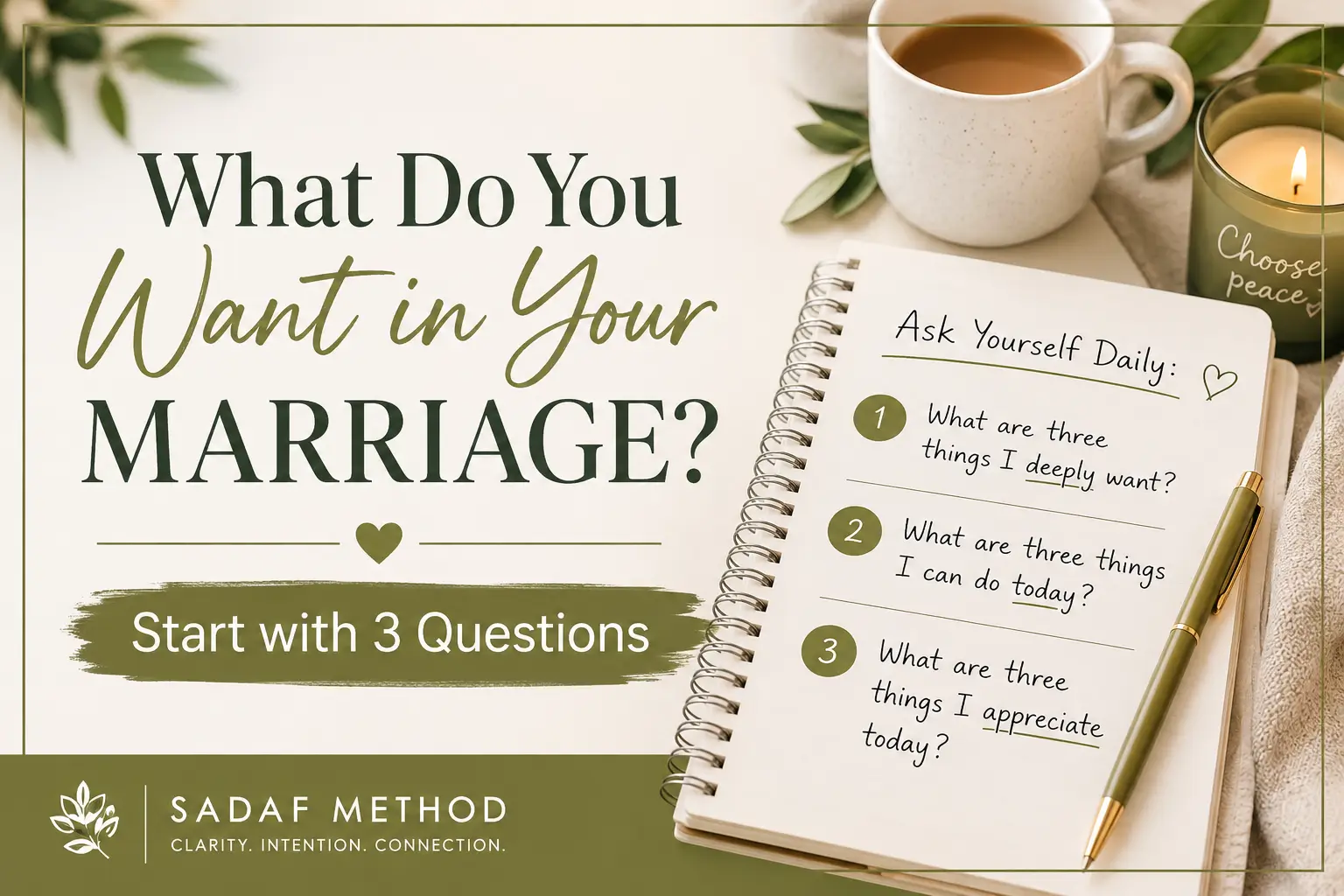
What Do You Want In Your Marriage: Start With 3 Questions
Have you ever been asked, “What do you want in your marriage?” and realized you weren’t sure how to answer?
Many women can easily describe what they don’t want.
- “I don’t want to argue anymore.”
- “I don’t want to feel ignored.”
- “I don’t want to keep walking on eggshells.”
- “I don’t want to feel alone.”
But when it comes to describing the marriage they truly desire, they often struggle to put it into words.
That lack of clarity matters more than most people realize.
You cannot intentionally build something you have never clearly defined.
One of the biggest turning points in my own marriage happened when I stopped focusing on everything that was wrong and started asking myself a different question:
What do I actually want?
That simple shift changed how I communicated, how I thought, how I prayed, and how I showed up every day.
Today, this question has become the first step in my SADAF Method.
The First A in the SADAF Method Is Ask
The first A stands for Ask.
Every day, I encourage women to ask themselves three simple but powerful questions:
- What are five things I deeply want?
- What are five things I can do today to move toward them?
- What are five things I appreciate today?
These questions shift your attention away from fear, blame, and frustration and toward clarity, action, and gratitude.
Many women spend years asking questions like:
- Why is he like this?
- Why doesn’t he understand me?
- Will my marriage ever change?
While those questions are understandable, they rarely create forward movement.
The questions you ask yourself determine the direction of your attention.
And your attention influences your emotions, your words, your decisions, and ultimately the atmosphere you help create inside your marriage.
If you’ve already read about the SADAF Method, you’ll recognize that asking better questions lays the foundation for every step that follows.
Without clarity, it’s difficult to smile intentionally, dream about a better future, add value consistently, or stay focused when progress feels slow.
Everything begins with asking yourself the right questions.
Why Most Women Feel Stuck
When women first come to me for coaching, they usually tell me everything that hurts.
“My husband doesn’t listen.”
“He never initiates affection.”
“We barely talk.”
“I’ve tried everything.”
Those struggles are real.
But after listening carefully, I often notice something surprising.
They have spent months—or sometimes years—thinking about the problems, yet they have never clearly defined the relationship they want to create.
Imagine trying to build a house without a blueprint.
Imagine starting a road trip without choosing a destination.
No matter how hard you work, you’ll keep moving without knowing whether you’re getting closer.
The same thing happens in marriage.
Without clarity, every disagreement feels bigger.
Every disappointment feels permanent.
Every setback feels like proof that nothing will ever change.
Clarity gives your heart a direction.
Instead of constantly reacting to what is happening today, you begin intentionally moving toward the relationship you want tomorrow.
Stop Focusing Only on What You Don’t Want But Start Focusing on What Do You Want In Your Marriage
Our minds naturally notice problems.
If your marriage has been difficult for a long time, your thoughts may sound like this:
- I don’t want another argument.
- I don’t want to be ignored.
- I don’t want him to criticize me.
- I don’t want to feel rejected.
While these thoughts are understandable, they keep your attention centered on pain.
Instead, gently begin replacing them with questions that point toward the future.
Ask yourself:
- How do I want to feel in my marriage?
- What kind of wife do I want to become?
- What kind of conversations do I want us to have?
- What kind of home do I want to create?
- What memories do I hope we’re making one year from now?
Notice the difference.
Instead of rehearsing what you’re trying to escape, you’re beginning to define what you’re working toward.
That shift changes the way you think, speak, and act every day.
Clarity Changes More Than Your Marriage
Many women believe they need their husband to change before they can experience peace.
In reality, clarity often changes you first.
When you’re clear about what matters most:
- You communicate more calmly.
- You stop chasing every disagreement.
- You become more intentional with your words.
- You recognize opportunities for connection that you previously overlooked.
- You make decisions based on your values instead of your emotions.
This doesn’t mean your husband changes overnight.
It means you stop living reactively.
That alone can completely change the emotional atmosphere in your home.
This is one of the reasons I encourage women to spend a few minutes each day answering the three Ask questions.
Small moments of intentional reflection often produce much bigger changes than endless hours of worrying.
Three Questions That Can Transform Your Thinking
Let’s look more closely at the three daily questions.
1. What Are Five Things I Deeply Want?
These are not material goals.
They’re the emotional experiences you’re hoping to create.
For example:
- I want peaceful conversations.
- I want to laugh together again.
- I want to feel emotionally safe.
- I want to enjoy spending time together.
- I want our home to feel calm.
Don’t judge your answers.
Simply become aware of them.
The clearer your vision becomes, the easier it is to recognize opportunities to move toward it.
2. What Are Five Things I Can Do Today?
This question shifts you from wishing to acting.
Instead of asking whether your husband will change, ask what you can control today.
Maybe you can:
- Smile when he walks through the door.
- Thank him for something specific.
- Speak gently during a disagreement.
- Ask about his day with genuine curiosity.
- Pray for him.
- Take care of your own physical and emotional well-being.
These actions may seem small, but consistent small actions often create the greatest long-term change.
They also help you become the kind of person you’re hoping to be—regardless of someone else’s choices.
3. What Are Five Things I Appreciate Today?
Gratitude doesn’t ignore pain.
It prevents pain from becoming the only thing you notice.
Even during difficult seasons, there is usually something worth appreciating.
Perhaps it’s:
- Your health.
- Your children.
- A peaceful conversation.
- A shared meal.
- A smile.
- A lesson you’ve learned.
- God’s guidance through a difficult season.
Appreciation softens the heart.
It creates space for hope without pretending everything is perfect.
Over time, many women discover that this simple daily habit changes the emotional lens through which they view their marriage.
Exercise 1: Write Your Ideal Marriage Day
Now it’s time to move from thinking to writing.
Take out a notebook and imagine waking up one year from today.
Your marriage isn’t perfect.
But it’s healthy.
It’s peaceful.
It’s connected.
Describe an ordinary day from morning until bedtime.
Ask yourself:
- How do you wake up?
- How do you greet each other?
- What conversations do you have?
- How do you handle disagreements?
- What makes you feel loved?
- What makes him feel appreciated?
- What does dinner look like?
- How do you end the day together?
Don’t worry about whether this feels realistic.
This exercise isn’t about predicting the future.
It’s about defining the direction you’re choosing to move toward.
Once you’ve written your ideal day, you’ll begin noticing opportunities to take small steps toward making pieces of that vision part of your everyday life.
Exercise 2: Create Your Love and Connection List
Many women tell me,
“I just want my husband to love me.”
But what does that actually mean?
Love looks different to different people.
One woman feels loved when her husband sits and talks with her after dinner. Another feels loved when he reaches for her hand. Someone else feels most loved when he notices her efforts and expresses appreciation.
The more specific you become, the easier it is to recognize progress and communicate your needs clearly.
Instead of writing one general sentence, make a detailed list.
Complete sentences such as:
- I feel most loved when…
- I feel emotionally safe when…
- I feel appreciated when…
- I feel connected when…
- I feel respected when…
- I feel closest to my husband when…
Your answers might include:
- We laugh together.
- He asks about my day.
- We pray together.
- We drink coffee together in the morning.
- We solve problems without yelling.
- We spend uninterrupted time together.
- We hug before leaving the house.
- He thanks me for something I did.
- We make decisions as a team.
Notice that these are all behaviors—not assumptions.
Instead of saying,
“I want him to love me.”
you’ve created a practical picture of what love looks like in everyday life.
That clarity makes healthy communication much easier.
Exercise 3: Identify What You’re Settling For
This next exercise requires honesty—but it can also be incredibly freeing.
Ask yourself:
What am I settling for that I no longer want to accept as normal?
Perhaps you’ve become used to:
- Constant criticism.
- Walking on eggshells.
- Emotional distance.
- Never making time for each other.
- Avoiding difficult conversations.
- Living like roommates instead of partners.
Recognizing these patterns isn’t about blaming your husband.
It’s about becoming aware of what has quietly become “normal.”
Awareness is the first step toward change.
Once you recognize unhealthy patterns, you can begin replacing them with healthier habits one small step at a time.
Remember: You Can Control Only One Person
One of the hardest lessons in marriage is accepting that you cannot force another person to change.
You cannot control:
- His thoughts.
- His choices.
- His reactions.
- His timing.
But you can control:
- Your attitude.
- Your words.
- Your actions.
- Your habits.
- Your responses.
- Your personal growth.
This truth isn’t limiting.
It’s liberating.
The moment you stop spending all your energy trying to change someone else, you have more energy available to become the woman you want to be.
Ironically, this often changes the emotional atmosphere of the relationship.
Small Daily Choices Create Big Change
Many people wait for one dramatic breakthrough.
Healthy marriages are usually rebuilt differently.
They grow through hundreds of small moments.
One smile.
One kind word.
One sincere thank you.
One calm conversation.
One apology.
One prayer.
One encouraging text.
One thoughtful question.
None of these moments seem life-changing on their own.
Together, they become the culture of a marriage.
That’s why the second question in the Ask step is so powerful:
What are five things I can do today?
Not next month.
Not after he changes.
Today.
Small actions repeated consistently become lasting habits.
From Clarity to Action
Knowing what you want is only the beginning.
The next step is acting consistently.
That’s why the Ask step comes first in the SADAF Method.
Once you’re clear about what you deeply want, you’re ready to:
- Smile even when life feels stressful because your attitude influences the atmosphere in your home.
- Day Dream about the marriage you’re intentionally working toward instead of constantly replaying painful memories.
- Add Value to yourself, your husband, and the people around you through kindness, growth, and service.
- Focus on consistent daily progress instead of expecting overnight transformation.
Each step builds on the previous one.
Without clarity, it’s difficult to practice the other four consistently.
What If Your Husband Doesn’t Change?
This is one of the questions I hear most often.
The honest answer is that no one can promise another person’s choices.
But I have seen something remarkable happen repeatedly.
When women become calmer, clearer, and more intentional, they often change the emotional environment of their marriage.
Arguments become less frequent.
Communication becomes more respectful.
Fear begins to decrease.
Hope slowly returns.
Sometimes husbands respond quickly.
Sometimes the changes are gradual.
Sometimes the greatest transformation begins inside the woman herself before anyone else notices.
Regardless of how your husband responds, becoming more intentional benefits you.
You gain confidence.
You communicate with greater clarity.
You make healthier decisions.
You become less reactive and more purposeful.
Those are valuable changes regardless of anyone else’s behavior.
Your Marriage Doesn’t Have to Be Perfect
Many women think healing means never disagreeing again.
Healthy marriages still have disagreements.
Healthy marriages still experience stress.
Healthy marriages still face disappointment.
The difference is that both people continue moving toward connection instead of away from it.
Progress matters more than perfection.
Every peaceful conversation…
Every act of appreciation…
Every moment of patience…
Every intentional decision…
becomes another brick in rebuilding trust and emotional closeness.
The goal isn’t perfection.
The goal is moving in the right direction—one day at a time.
Frequently Asked Questions: What Do You Want In Your Marriage
What do you want in your marriage?
The answer is different for every woman. Instead of focusing only on what you want your husband to stop doing, think about what you want your relationship to become. Do you want more peace? Better communication? More affection? Greater trust? The clearer your vision becomes, the easier it is to make intentional choices that support it.
Why is it important to know what I want in my marriage?
Clarity gives your relationship direction. When you know what you’re working toward, you communicate more effectively, make healthier decisions, and spend less energy reacting to problems.
Can my marriage improve if only I am working on it?
A healthy marriage involves two people, and no one can guarantee how another person will respond. However, when one spouse begins communicating differently, becoming more intentional, and creating a calmer emotional environment, the relationship dynamic often begins to shift.
How often should I ask myself these three questions?
I recommend making them part of your daily routine. Spend just five minutes each morning or evening asking:
- What are five things I deeply want?
- What are Five things I can do today?
- What are five things I appreciate today?
Small moments of reflection repeated consistently can create meaningful long-term change.
Isn’t focusing on what I want selfish?
Not at all. Understanding your needs allows you to communicate them with kindness and clarity instead of frustration and resentment. Healthy marriages grow when both spouses understand themselves and each other better.
What if I don’t know what I want anymore?
That is more common than you may think. Many women have spent years focusing on everyone else’s needs that they’ve lost touch with their own. Start small. Ask yourself how you want to feel in your marriage. The answers will become clearer over time.
Begin with One Question
If your marriage has been painful, you may feel tempted to search for the perfect communication technique, the perfect book, or the perfect words to finally change everything.
But lasting change usually begins much more quietly.
It begins with a question.
What do I truly want?
When you ask yourself that question honestly—and answer it consistently—you begin leading your marriage with intention instead of reacting from fear, disappointment, or frustration.
That’s why Ask is the first step in the SADAF Method.
Before you smile more intentionally…
Before you begin day dreaming about a better future…
Before you focus on adding value…
Before you strengthen your daily focus…
You first need clarity.
And clarity begins by asking yourself better questions.
Remember these three each day:
What are five things I deeply want?
What are five things I can do today to move toward them?
What are five things I appreciate today?
Simple questions.
Powerful direction.
Small daily choices practiced consistently often become the foundation of a stronger marriage.
You don’t have to figure everything out today.
Just begin with the next question.
Continue Your Journey
If this article helped you gain clarity, these resources can help you take the next step:
- Learn the complete SADAF Method to understand how Smile, Ask, Day Dream, Add Value, and Focus work together to strengthen your marriage.
- Read How to Program Your Subconscious Mind for the Relationship You Desire to learn how your daily thoughts influence your actions and relationships.
- Discover why adding value to yourself is one of the healthiest things you can do for your marriage by reading Overwhelmed and Tired? Start by Caring for Yourself.
- Explore the power of a genuine smile and how small daily interactions can gradually rebuild emotional connection.
- If you’re looking for personalized support, learn more about my Marriage Clarity Intensive, where we work together to create a practical plan for your unique relationship.
You don’t have to navigate this journey alone.